
Editorial
True Classic vs Buck Mason: Basics Checks Before Black Friday
Updated
StoreAtlas editors
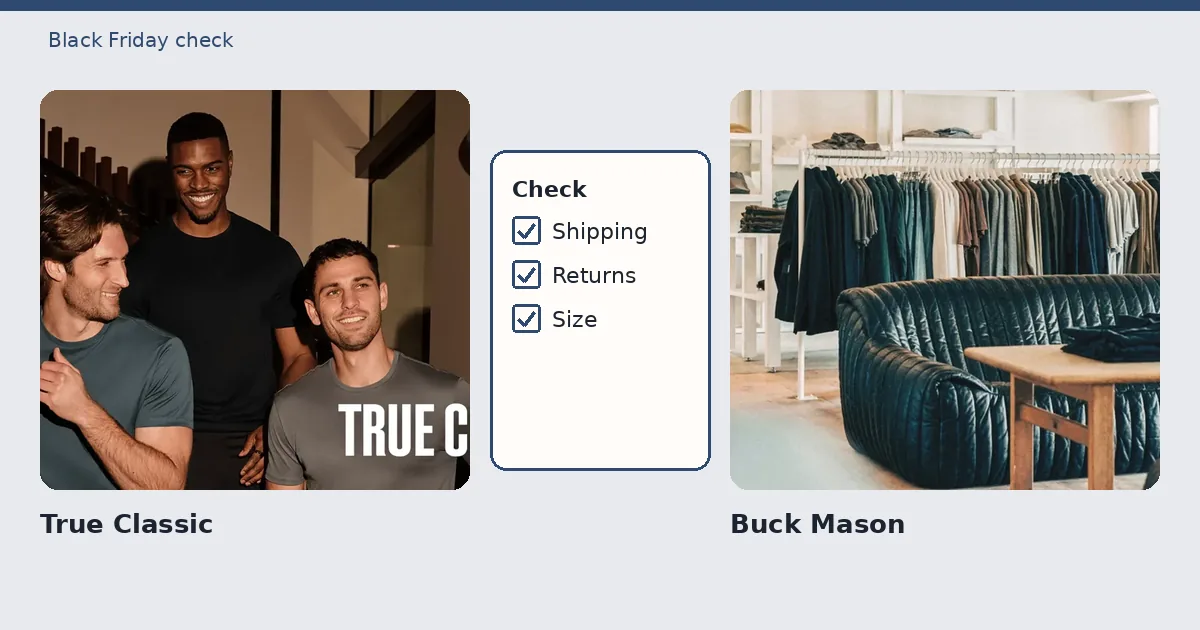
Read as Markdown · Before you buy
True Classic vs Buck Mason before Black Friday is a same-day basics check, not a ranking and not a redo of past markdowns. True Classic is the directory page for True Classic. Buck Mason is the directory page for Buck Mason. The brand hosts we opened were trueclassictees.com and buckmason.com. You are looking at one tee, one pack, or one pair of pants you would actually wear: which line names that unit, what shipping sentence sits beside it, and what the fit or returns sentence requires. A percent on a six-pack tile is not the percent on one shirt. This note does not print a token, does not name a winner, and does not tell a seller how to stock a shelf.
This pair is men’s basics. It is not a different apparel pair you may have read elsewhere. Stay on these two hosts.
The year-round neighbor is True Classic vs Buck Mason. Use it for the standing comparison. Use this note for the day-of pass. If either page changes after you leave, the live page wins.
On 5 November 2026 we requested both public homepages with a normal browser header. True Classic returned HTTP 200 on https://www.trueclassictees.com/. The title we could read named fitted tees. A line said we were browsing the United States store. Buck Mason returned HTTP 200 on https://www.buckmason.com/. The title named the brand. We do not repeat a store-status adjective that sat in that title. Neither save is a promise about tomorrow.
What the pages showed
True Classic painted “Black Friday” in more than one place: a “Black Friday Sale” label, a nav item, and a block titled “Hottest Black Friday Deals”. That block was a grid, not one rate. One tile we could read was a six-pack classic long-sleeve crew, marked 50% off, with a sale price beside a higher list price. Neighboring six-pack tiles, including an active crew and a tall classic crew, were marked 57% off, again with their own sale price and list price. Those are different products and different marks. A single tee does not inherit 50% or 57% because a six-pack tile printed it. Do not average 50 and 57 into a new number. Do not paste either mark onto a color or a size the tile did not name.
An empty-cart prompt said add $124 to get free shipping. That sentence is a cart gap, not a claim that every order ships free. A separate membership panel described an insiders club: a charge of $12 a year, free standard shipping on every order with no minimum, a line about paying less, and a line about store credit. Those clauses belong to the membership panel. They are not the six-pack percent. A yearly charge is not a Black Friday rate. This note does not tell you to join. If you are not looking at that panel, do not import its shipping sentence onto the $124 cart prompt. They can both be on the site and still answer different questions.
A guarantee block said every product comes with a 100-day guarantee: if it does not fit or wears too soon, tell them within 100 days and they will replace it. Beside it, an easy-returns line pointed at a support address and a phone number. A replacement guarantee is not the same sentence as a refund. The size guide said between sizes, size up for relaxed and down for fitted, and it listed weight bands. A weight band is a hint. The garment page still has to name your size. “Buy now pay later” was a label near the size guide. A payment label is not a percent off the shirt.
Buck Mason’s saved page did not contain the words “Black Friday” and did not contain a percent-off string we can cite. Silence stays silence. Do not borrow True Classic’s 50% or 57% and paint them here. The announcement we could read said shipping on us over $150 and 365-day returns. Two clauses. An order under $150 does not inherit the shipping clause. The 365-day returns clause is Buck Mason’s sentence, not True Classic’s 100-day sentence. Do not average 365 and 100.
Product tiles showed dollar prices on individual garments, including pants, jackets, and tees. A dollar price on one pant is not a sitewide mark. Nav and footer doors included new arrivals, outerwear, tailoring, pants, a journal, stores, markdown, returns and exchanges, and track package. “Markdown” as a door name is not a rate. “Best sellers” as a door name is their merchandising, not this note’s verdict. A machine-readable catalog was offered on the same host. That catalog is not a Black Friday banner. We do not quote it as a discount.
Rows to fill before you pay
Use one row per garment or pack, not one row per brand.
1. Host and country. True Classic’s line said the United States store. If you switch country, read shipping and the grid again. Buck Mason: confirm the currency in the cart before you rely on the $150 bar. 2. Unit. One tee, a six-pack, a tall fit, and a pair of pants are different units. A pack percent does not become a one-shirt percent unless the one-shirt page says so. 3. Which True Classic mark names this unit. 50% on one six-pack tile and 57% on another were separate. If your size is absent, the percent is about a different unit. Buck Mason: if no percent is printed, write “no percent on this read”, not a borrowed number. 4. Shipping story, and which story. True Classic showed both an add-$124 cart prompt and a membership panel with no-minimum shipping tied to a yearly charge. Write the story you are actually in. Buck Mason named over $150. Under that figure, the clause we read does not apply. 5. Fit window versus refund window. True Classic’s 100-day block was a replacement guarantee tied to fit and early wear. Buck Mason’s bar named 365-day returns. Read the policy door before you decide what “returns” includes. A replacement is not automatically a refund. 6. Size method. True Classic printed weight bands and a relaxed-versus-fitted hint. Buck Mason tiles named garment names and prices, not a weight chart on the homepage save. Measure against the size table on the product page. 7. Membership and store credit. If those words appear only inside a club panel, they are not a property of the six-pack tile. Leave them out of the tile row. 8. Cart. The grid price and the cart can diverge. The review screen is the check. A door named markdown does not apply itself.
What people mix up
A six-pack tile feels like the price of a drawer of shirts. It is the price of that pack. One shirt is a different unit. Tall and regular were different tiles even when the percent matched.
A membership shipping perk feels like the empty-cart bar. True Classic showed both. The $124 prompt and the no-minimum club line are different sentences. Joining is a separate decision from buying one pack.
A 100-day replacement feels like a 365-day return because both are long. They are different hosts and different nouns. Write the noun the page used.
A missing Black Friday headline feels like a store that confirmed full price. Buck Mason’s page did not show the words. “Not shown” is not “confirmed full price”. The tiles still showed dollar prices. Read the tile you want.
A markdown door feels like an event percent. It is a link. Open it or leave the cell blank. Do not invent the percent the door did not print on the homepage.
A weight band feels like your size. It is a range. Between sizes, the guide itself said the direction depends on relaxed versus fitted. That hint is still not the cart.
How to use the two store pages
Open True Classic and Buck Mason only as directory context. Then open the brand hosts and do the rows. When you want the non-seasonal comparison, open True Classic vs Buck Mason. Other notes live on the blog. The store index is stores. The deal index is deals, used as a directory. The home page is only a start.
Skip this note if you will paste 57% onto a Buck Mason tee, or onto a True Classic unit the grid did not name. There is no winner in a column that says “no percent on this read”.
1. Set the country. Read the shipping sentence that matches your path. 2. Match the unit, including pack count and fit. 3. Write one percent only if that unit’s tile printed it. 4. Keep replacement language and returns language apart. 5. Read the cart. 6. Only then decide whether to wait or to pay.
When you are ready to order, use the brand site. When you want directory context, use the store directory.
Questions
- Did both homepages paint Black Friday?
- True Classic did, including a deals grid. Buck Mason’s saved page did not contain those words and did not contain a percent-off string we can cite. Silence is not a confirmed full price.
- Does 57% apply to one shirt?
- No. 50% and 57% were marks on different six-pack tiles. One shirt does not inherit a pack mark. Do not average the two marks.
- Which shipping sentence is the empty-cart one?
- The empty-cart prompt said add $124 to get free shipping. A separate membership panel described no-minimum shipping tied to a yearly charge of $12. Buck Mason’s bar said shipping over $150. Write the path you are actually in.
- What is the 100-day sentence?
- True Classic described a 100-day replacement guarantee tied to fit and early wear. That is not the same noun as Buck Mason’s 365-day returns clause. A replacement is not automatically a refund.
- Where does the cart sit?
- Last. A door named markdown is not a rate. A machine-readable catalog is not a banner. If the cart disagrees with the grid, the cart wins.